
The inappropriate use of models
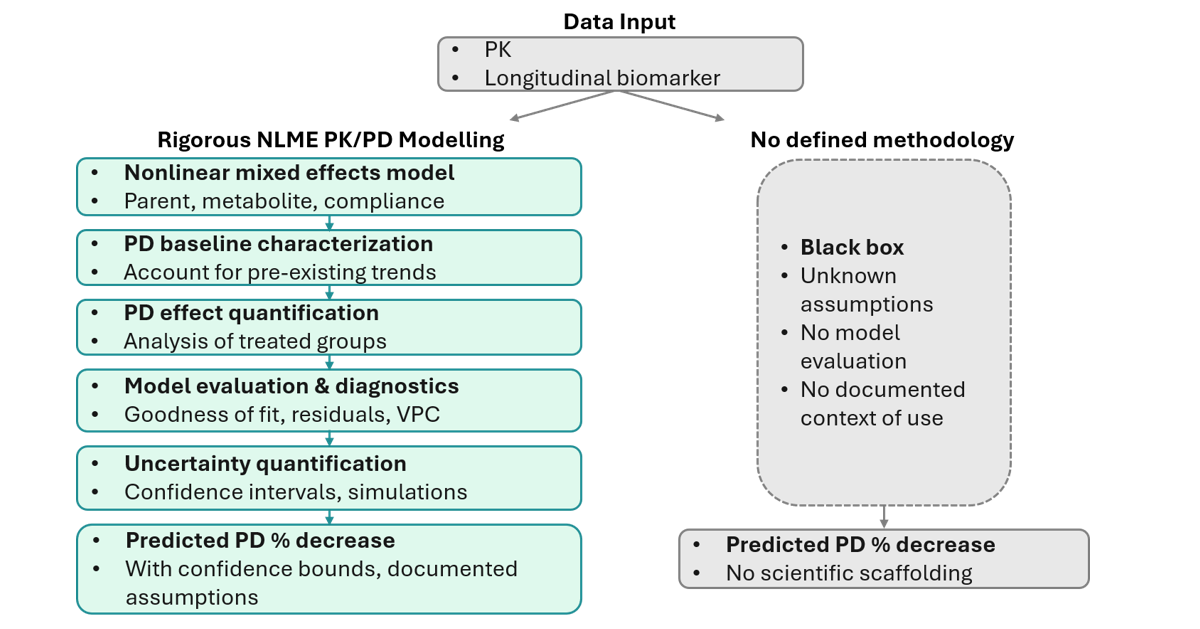
Consider this scenario. A go/no-go criterion is set on achieving 10% decrease on a certain biomarker after 10 months of treatment. The endpoint is well validated and the question is clean. The raw data collected consists of longitudinal measures of the biomarker (not just at 10 months). What makes the question scientifically complex is the presence of a baseline effect, nonlinear pharmacokinetics, and contributions from both parent compound and metabolite, and patient compliance.
A pharmacokinetic/pharmacodynamic (PK/PD) scientist would know how to tackle the problem, as there is pretty much a scientific road map on how to deal with the complexities presented using nonlinear mixed effects modelling and other very elegant solutions that senior scientists may propose.
Here comes the biggest challenge, and it is not a scientific one in the traditional sense. Someone without any training in quantitative data analysis whatsoever puts the same data into an AI tool and obtains a different predicted percentage decrease at the "proposed safe dose". That number is then used to influence decision making and the design of the next study, meaning the choice of doses, regimens, and formulations.
It is incredibly hard to argue against a result that carries the weight of a sophisticated tool behind it. And most of it comes from the perception that AI is the solution to everything. But the tool is not the problem. I am mostly concerned about those who would accept any result on the face of it, without questioning where it came from, which assumptions were used, and what confidence underlies the prediction shown.
Model construction, evaluation, and interpretation require dedicated training. The assumptions, diagnostics, and context of use are not details, they are the substance of the analysis. Get them wrong and the model does not just fail to help, it actively misleads. Pharmacokinetic and pharmacodynamic analysis is a science that has been challenged, tested, extended, and accepted by regulatory authorities for decades, applied daily by specialists to help drug development teams take their next step with confidence.
New analytical methods are more than welcome in the field and extremely necessary for advancement of science. Progress is vital to better, safer medicines and meaningful impact on patients' lives. But we have a collective responsibility to challenge any result that appears without scientific accountability, without model evaluation, without documented assumptions, and without a defined context of use. Otherwise we would be effectively discarding the data-driven approach and the rigour of scientific methods, returning to a blind trial and error approach.
It is telling that the ICH M15 guidance on model-informed drug development intentionally presents a high-level description of model evaluation and general recommendations in order to facilitate use across M&S methods. But that deliberate agnosticism points to something deeper, a truth that is valid for any model. The context of use, fitness for purpose, impact of model on decisions, and model risk are factors common to diverse disciplines that do not require deep technical expertise to be understood. They are the foundation of a common language. It is therefore the responsibility of modellers, of those with the deep technical knowledge, to make these key modelling insights transparent to project teams and ultimately to decision makers.
ICH M15 defines model risk as the contribution of the model outcomes to a possible wrong decision and subsequent potential undesirable consequences. In the scenario described, the rigorously constructed NLME model carries characterised and manageable risk, documented through evaluation, diagnostics, and defined assumptions. The unvalidated tool carries unknown risk. No assumptions are documented, no evaluation performed, no context of use defined. A number produced under those conditions does not reduce risk. It obscures it, because it creates the illusion of an answer where none has been properly derived.
A technically well-constructed model is already dangerous when applied outside its intended context. A poorly constructed one, applied without evaluation, without documented assumptions, without a defined context of use, is not a model at all. It is a number with a confident face.
As modellers, our responsibility does not end when the analysis is complete. It extends to how results are communicated, interpreted, and used. And for everyone working alongside quantitative scientists, the responsibility is equally clear: before acting on a number, ask what model produced it, what assumptions underpin it, what it was designed to predict, and whether it has been properly evaluated. If the answer to any of those questions is unclear, the number has no scientific standing and no place in a development decision.
Regulatory authorities will not accept it. Neither should you.
Reference:
ICH M15 Guideline: General Principles for Model-Informed Drug Development. International Council for Harmonisation of Technical Requirements for Pharmaceuticals for Human Use. February 2026.