
How can a landmark drug go from accelerated approval to voluntary market withdrawal?
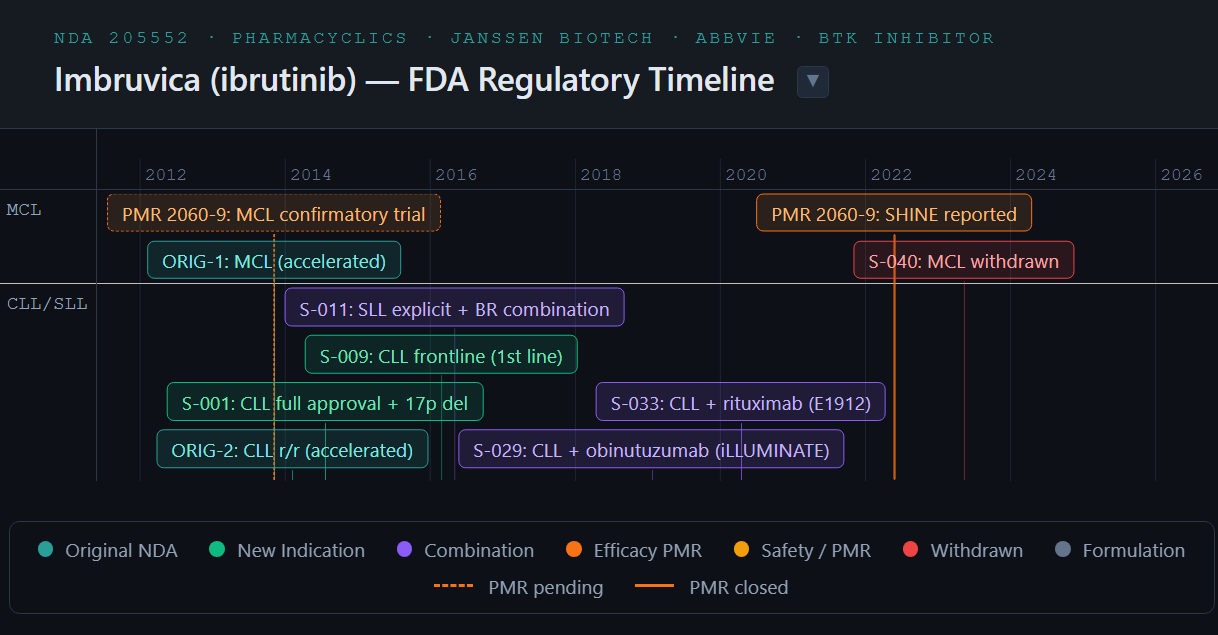
The regulatory landscape is not fixed, it is ever evolving. The decisions and evidence put together right now would not likely result in the same regulatory response 5 years down the line. And the reason for that is two fold: 1) the regulatory rationale is changing and evolving as it needs to be, and 2) the competitors, the knowledge around the target or indication prior to a drug development submission package carries significant weight on decisions.
Let's delve into an amazing example of a landmark drug which has started its journey in 2013 with accelerated approval and orphan drug designation.
Compound: Ibrutinib Target: Bruton's tyrosine kinase (BTK) Overall indication: Oncology, B-cell malignancies
The biology itself is fascinating as it is a textbook example of small molecule targeted therapies. Mantle cell lymphoma (MCL) is caused by de-regulation of cyclin D1 due to chromosome translocation, ultimately driving cell proliferation. Chronic lymphocytic leukemia (CLL) is driven by a different mechanism, the accumulation of monoclonal mature B-cells through failed apoptosis. Although CLL is usually indolent with slow progression, chromosomal deletion (17p) makes CLL rapidly advancing and aggressive, since it disables the p53 gene, known to protect cells from uncontrolled proliferation [1]. In both diseases, malignant B-cells rely heavily on B-cell receptor (BCR) signalling for their survival, proliferation and tissue homing. BTK is a critical kinase in this signalling pathway, making it an attractive therapeutic target. By irreversibly binding to BTK, ibrutinib blocks BCR signalling, disrupting the survival and proliferation of malignant B-cells and their ability to migrate to and remain within supportive tissue microenvironments such as lymph nodes and bone marrow.
In the original ibrutinib NDA submission, approval was sought for both of these indications, and even though the single arm efficacy study showing an overall response rate (ORR) of 65.8% and sustained BTK occupancy (>90%) at steady state was deemed sufficient for MCL, the FDA raised issues around the interpretation of the efficacy for patients enrolled in the CLL efficacy study, deferring its approval.
Regulatory approval is the decision that ultimately determines whether a promising therapy reaches the patients who need it, and for accelerated approval, granted on the basis of an incomplete data package, this decision relies heavily on the primary endpoint result, which for these trials was ORR. This means the definition of what constitutes a complete or partial response was taken with extreme caution and scrutiny by the agency. Response criteria in oncology are established by expert international consensus groups, such as the International Workshop on CLL (iwCLL) for CLL and the International Working Group for lymphomas (IWG) for MCL, and adopted by regulatory agencies as the evidentiary standard for approval. However, when a genuinely novel therapeutic modality arrives, these frameworks must also adapt, and ibrutinib brought an interesting challenge to both.
For MCL, ibrutinib was the first regulatory application of the 2007 IWG Response Criteria in this indication [2]. These criteria introduced FDG-PET scanning as a component of complete response assessment, but the prognostic significance of PET-based complete responses had not yet been clinically validated in MCL at the time of ibrutinib's approval, adding a layer of uncertainty to the efficacy conclusions.
For CLL, the challenge was different in nature but equally fundamental. A phenomenon called redistribution lymphocytosis, occurring in 77% of patients [3, 4], rendered the standard 2008 iwCLL response assessment framework inadequate for a BTK inhibitor. Because ibrutinib disrupts tissue homing, CLL cells migrate from lymph nodes into peripheral blood, causing a paradoxical rise in circulating lymphocyte counts that standard criteria would classify as disease worsening rather than pharmacological activity. The sponsor applied modified criteria to address this, introducing partial response with lymphocytosis as a new response category and allowing evaluation in patients with a single abnormal baseline compartment [4]. Beyond the criteria themselves, the characterization of PR proved challenging in practice, with the investigator assessment identifying 37 partial responses while the independent review committee assessed only 27 out of 48 patients, quite a difference [5]!
While the CLL NDA was submitted in June 2013 on a 48-patient single arm dataset, another study (RESONATE, NCT01578707) was concomitantly running comparing ibrutinib against ofatumumab in previously treated CLL. During the review of the NDA, the FDA was made aware of the stellar results obtained in the RESONATE study, which crossed the pre-specified efficacy boundary at the preplanned interim analysis, demonstrating a significant increase in the duration of progression-free survival: the hazard ratio for progression or death in the ibrutinib group was 0.22 (95% CI, 0.15 to 0.32; P<0.001), representing a 78% reduction in the risk of progression or death among patients treated with ibrutinib, as compared with ofatumumab [6].
The FDA was essentially making the accelerated approval decision in real time as confirmatory evidence surfaced, a beautiful illustration of the regulatory process being responsive to emerging data and putting patients first. Ibrutinib for the treatment of CLL was and continues to be a success, with full approval granted shortly after and clear patient benefit demonstrated.
Back to the MCL story, which is not as linear. As part of accelerated approval, the FDA mandates post-marketing requirements (PMR) which include confirmatory trials to substantiate the early efficacy claims. In the approval letter for the MCL indication [7], the confirmatory trial was designated as the ongoing Phase 3 study (PCI-32765MCL3002, NCT01776840, SHINE) of ibrutinib in combination with bendamustine and rituximab in patients with newly diagnosed MCL.
It is worth noting that at the time of the accelerated approval in November 2013, two randomised phase 3 trials were already ongoing in MCL. SHINE was evaluating ibrutinib in combination with BR in treatment naive elderly patients, while the RAY trial (PCI-32765MCL3001, NCT01646021) was comparing ibrutinib monotherapy against temsirolimus in relapsed/refractory MCL, the exact population and treatment setting of the approved indication. RAY had actually started enrollment in December 2012, several months before SHINE. The FDA nonetheless designated SHINE as the confirmatory PMR, a choice that remains difficult to fully explain from public documents alone, and one with far reaching consequences. PMRs under the accelerated approval pathway are legally binding, meaning that once SHINE was designated, both the sponsor and the agency were committed to that evidentiary framework. When SHINE results proved insufficient, there was limited regulatory flexibility to substitute alternative evidence, even where such evidence existed in the original approved population.
At the time SHINE was designed, the relationship between PFS and OS in MCL had not been formally validated. Analyses published as recently as 2024 and 2026 have since demonstrated only a moderate correlation between the two endpoints in this disease, questioning the suitability of PFS as a surrogate for OS in MCL [8, 9]. Furthermore, the choice of a treatment naive elderly population, where the disease is inherently slow to progress, predictably created a long event accrual timeline. Historical data available at the time, including the StiL trial published in 2013, showed that median PFS in treatment naive MCL patients on BR-based chemoimmunotherapy exceeded 5 years, suggesting that a PFS-driven confirmatory trial in this population would require many years of follow-up to mature [10].
Another important factor was that the competitive landscape had shifted dramatically between 2013 and 2023. Second generation BTK inhibitors like acalabrutinib and zanubrutinib had emerged with better selectivity and cleaner safety profiles, making ibrutinib's risk-benefit in MCL look even less favourable by comparison. Ibrutinib reached its primary PFS endpoint in SHINE but did not improve OS. The median progression-free survival was 80.6 months in the ibrutinib group, as compared with 52.9 months in the placebo group (HR 0.75, p=0.01) [11]. The 7-year OS rate was virtually identical, 55.0% for ibrutinib versus 56.8% for placebo, HR 1.01, essentially no difference. In the context of a competitive landscape that now offered better tolerated alternatives, a PFS benefit without OS benefit was not sufficient to tip the risk-benefit balance in ibrutinib's favour.
The ibrutinib MCL story raises a question that the public documents alone cannot fully answer. The RAY trial, which was already enrolling at the time of the accelerated approval and completed in the same population and treatment setting as the approved indication, showed clear superiority of ibrutinib over temsirolimus in relapsed/refractory MCL [12]. Whether the sponsor could have used those results to argue for full approval in the original indication, rather than accepting withdrawal after SHINE, remains an open question.
What we do know is that a decade after accelerated approval, ibrutinib was voluntarily withdrawn from the MCL indication. Not because it was an ineffective drug, but because the regulatory framework built around it, the confirmatory trial chosen, the endpoint selected, and the timeline that followed, played out in a landscape that looked very different in 2023 than it did in 2013.
And that, perhaps, is the most important lesson of all. In drug development, the regulatory decisions made today will be judged by the scientific and competitive landscape of tomorrow.
References
[1] Campo E, Cymbalista F, Ghia P, et al. TP53 aberrations in chronic lymphocytic leukemia: an overview of the clinical implications of improved diagnostics. Haematologica. 2018;103(12):1956-1968. doi:10.3324/haematol.2018.187583. PMCID: PMC6269313.
[2] Cheson BD, Pfistner B, Juweid ME, Gascoyne RD, Specht L, Horning SJ, Coiffier B, Fisher RI, Hagenbeek A, Zucca E, Rosen ST, Stroobants S, Lister TA, Hoppe RT, Dreyling M, Tobinai K, Vose JM, Connors JM, Federico M, Diehl V; International Harmonization Project on Lymphoma. Revised response criteria for malignant lymphoma. J Clin Oncol. 2007 Feb 10;25(5):579-86. doi:10.1200/JCO.2006.09.2403. Epub 2007 Jan 22. PMID: 17242396.
[3] Raedler LA. Imbruvica (Ibrutinib), First-in-Class Bruton's Tyrosine Kinase Inhibitor, Receives Expanded Indications for Patients with Relapsed Chronic Lymphocytic Leukemia. Am Health Drug Benefits. 2015 Mar;8(Spec Feature):66-69. PMID: 26629268; PMCID: PMC4665055.
[4] Verdun N. Clinical Review, NDA 205552 Original-2, Ibrutinib. US Food and Drug Administration; February 10, 2014. https://www.accessdata.fda.gov/drugsatfda_docs/nda/2014/205552Orig2s000MedR.pdf
[5] Wang Y. Statistical Review and Evaluation, NDA 205552 Original-2, Ibrutinib. US Food and Drug Administration; January 31, 2014. https://www.accessdata.fda.gov/drugsatfda_docs/nda/2014/205552Orig2s000StatR.pdf
[6] Byrd JC, Brown JR, O'Brien S, Barrientos JC, Kay NE, Reddy NM, Coutre S, Tam CS, Mulligan SP, Jaeger U, Devereux S, Barr PM, Furman RR, Kipps TJ, Cymbalista F, Pocock C, Thornton P, Caligaris-Cappio F, Robak T, Delgado J, Schuster SJ, Montillo M, Schuh A, de Vos S, Gill D, Bloor A, Dearden C, Moreno C, Jones JJ, Chu AD, Fardis M, McGreivy J, Clow F, James DF, Hillmen P; RESONATE Investigators. Ibrutinib versus ofatumumab in previously treated chronic lymphoid leukemia. N Engl J Med. 2014 Jul 17;371(3):213-23. doi:10.1056/NEJMoa1400376. Epub 2014 May 31. PMID: 24881631; PMCID: PMC4134521.
[7] Pazdur R. Accelerated Approval Letter, NDA 205552 Original-1, Imbruvica (ibrutinib) Capsules, 140 mg. US Food and Drug Administration; November 13, 2013. https://www.accessdata.fda.gov/drugsatfda_docs/appletter/2013/205552Orig1s000ltr.pdf
[8] Bommier C, Maurer MJ, Lambert J. What clinicians should know about surrogate end points in hematologic malignancies. Blood. 2024 Jul 4;144(1):11-20. doi:10.1182/blood.2023022269. PMID: 38603637.
[9] Gorzewski AM, Raker C, Gill VA, Palladino T, Kota SP, Pelcovits AR. Association Between Progression-Free Survival and Overall Survival in Mantle Cell Lymphoma: A Trial-level Surrogate Endpoint Analysis. Clin Lymphoma Myeloma Leuk. 2026 Jul;26(7):e969-e977. doi:10.1016/j.clml.2026.05.001. Epub 2026 May 5. PMID: 42177127.
[10] Rummel MJ, Niederle N, Maschmeyer G, Banat GA, von Grünhagen U, Losem C, Kofahl-Krause D, Heil G, Welslau M, Balser C, Kaiser U, Weidmann E, Dürk H, Ballo H, Stauch M, Roller F, Barth J, Hoelzer D, Hinke A, Brugger W; Study group indolent Lymphomas (StiL). Bendamustine plus rituximab versus CHOP plus rituximab as first-line treatment for patients with indolent and mantle-cell lymphomas: an open-label, multicentre, randomised, phase 3 non-inferiority trial. Lancet. 2013 Apr 6;381(9873):1203-10. doi:10.1016/S0140-6736(12)61763-2. Epub 2013 Feb 20. PMID: 23433739.
[11] Wang ML, Jurczak W, Jerkeman M, Trotman J, Zinzani PL, Belada D, Boccomini C, Flinn IW, Giri P, Goy A, Hamlin PA, Hermine O, Hernández-Rivas JÁ, Hong X, Kim SJ, Lewis D, Mishima Y, Özcan M, Perini GF, Pocock C, Song Y, Spurgeon SE, Storring JM, Walewski J, Zhu J, Qin R, Henninger T, Deshpande S, Howes A, Le Gouill S, Dreyling M; SHINE Investigators. Ibrutinib plus Bendamustine and Rituximab in Untreated Mantle-Cell Lymphoma. N Engl J Med. 2022 Jun 30;386(26):2482-2494. doi:10.1056/NEJMoa2201817. Epub 2022 Jun 3. PMID: 35657079.
[12] Dreyling M, Jurczak W, Jerkeman M, Silva RS, Rusconi C, Trneny M, Offner F, Caballero D, Joao C, Witzens-Harig M, Hess G, Bence-Bruckler I, Cho SG, Bothos J, Goldberg JD, Enny C, Traina S, Balasubramanian S, Bandyopadhyay N, Sun S, Vermeulen J, Rizo A, Rule S. Ibrutinib versus temsirolimus in patients with relapsed or refractory mantle-cell lymphoma: an international, randomised, open-label, phase 3 study. Lancet. 2016 Feb 20;387(10020):770-8. doi:10.1016/S0140-6736(15)00667-4. Epub 2015 Dec 7. PMID: 26673811.